 Medicine Innovates Medicine Innovates: Delivering innovations in medicine to the world for better health and prosperity

Significance
Membrane integrity fails abruptly when a lytic peptide can insert into the plasma bilayer faster than the cell can buffer surface stress, and that possibility has unusual importance in cancers that no longer respond to treatments directed mainly at proteins and nucleic acids. In a recent research paper published in Cancer Research Journal, Dr. Utsarga Adhikary, Dr. Bethany Tesar, Dr. Kamal Patel, Dr. Michael Schmidt, Dr. Hannah Levy, Dr. Eva Zacharakis, Dr. Marina Godes, Dr. Prafulla Gokhale, Dr. Kyle Hebert, Dr. Donna Neuberg, Dr. Gregory Bird and led by Professor Loren Walensky from the Dana-Farber Cancer Institute, developed StAMP51.2 as a stapled oncolytic peptide prototype for selective targeting of cancer cell membranes, repurposing a scaffold originally engineered for bacterial membrane lysis. They also developed a response framework in which high TAG and low CE abundance marks susceptibility, whereas CE enrichment and cholesterol-biosynthetic rewiring accompany resistance. By combining broad cancer-cell profiling with lipidomics, transcriptomics, functional cholesterol depletion, and in vivo leukemia models, they defined a linked lipid–inflammatory axis that explains response to membrane-directed peptide attack. Their focus is the cancer cell membrane as a therapeutic substrate: not an accessory structure around the malignant cell, but the material boundary that decides whether osmotic balance, compartmentalization, and survival remain possible. A membrane-rupturing event can kill quickly, and the new work frames that speed as relevant to tumors shaped by intratumoral heterogeneity and immune escape, since a direct biophysical insult does not depend on a single mutated enzyme or one preserved transcriptional program.
The difficulty has never been imagining membrane lysis as an anticancer mechanism. The problem has been selectivity. Antimicrobial peptides provided a natural starting point because they already exploit membrane composition and surface charge, yet their translation has repeatedly run into injury to host membranes when the same amphipathic logic that disrupts microbes spills over into mammalian cells. That older problem matters here because cancer membranes and bacterial membranes share several compositional and biophysical traits, including higher fluidity and altered lipid presentation. Those commonalities make repurposing plausible, but they also mean that any therapeutic attempt has to distinguish malignant from healthy mammalian membranes with real structural discipline, not with vague expectations of preference.
The Walensky group entered this space from prior work on stapled antimicrobial peptides. Their earlier design logic had already identified a concrete determinant of mammalian membrane injury: continuity of hydrophobic patches along the helical face mattered more than bulk hydrophobicity alone. That is an unusually useful design principle because it converts selectivity from a general aspiration into something that can be engineered. By preserving cationic features associated with membrane engagement and disrupting uninterrupted hydrophobic surfaces through sequence change, they generated stapled peptides that lysed Gram-negative bacteria yet spared mammalian membranes. Hydrocarbon stapling also stabilized the alpha-helical state and improved resistance to proteolysis, which turns out to be central here because a membrane-directed anticancer peptide has to remain structurally intact long enough to reach disease sites through systemic delivery.
That earlier compound, StAMP51.2, gave them a way to address several longstanding obstacles at once. The new study frames prior oncolytic peptides as being held back by peptide instability, inconsistent efficacy, absent predictive biomarkers, and delivery routes that often remain local rather than systemic. The scientific motivation follows directly from those points. If stapling preserves structure and circulation-relevant stability, and if membrane selectivity can be rationalized through the surface organization of the peptide, then a bacterial membrane-lytic scaffold becomes a credible probe for asking which cancer membranes are actually permissive to rupture and why. The introduction keeps returning to one linked idea: membrane lysis is not only a killing mechanism but also an inflammatory event. That connection is what gives the project its deeper conceptual force. A successful membrane-directed agent would not simply destroy cells by physical breach; it could also expose how membrane composition and inflammatory competence are coupled inside malignant cells.
The group began broadly, screening StAMP51.2 across more than 750 genomically characterized cancer cell lines with the PRISM platform, and the breadth of that opening experiment matters because it let membrane susceptibility emerge as a distributed phenotype rather than as an anecdote from one favored model. Cytotoxicity increased with dose across lineages, with hematopoietic and lung malignancies showing strong sensitivity in the higher concentration range. They then paired the PRISM sensitivity profile with metabolomic data and pulled out a striking lipid pattern: susceptibility tracked with higher triacylglycerols and lower cholesteryl esters, whereas resistance tracked in the opposite direction. A membrane enriched in sterol-related features should be harder for a lytic peptide to penetrate, whereas a state associated with greater fluidity should make insertion and rupture easier. The biomarker was not left at the level of a large-scale association. They examined 92 hematopoietic lines, saw an inverse TAG/CE structure, and selected exemplars that made the contrast unusually clear, with OCI-AML3 representing the low-CE/high-TAG state and K562 the high-CE/low-TAG state.
Those paired models anchored the mechanistic part of the study. LDH release after brief exposure showed acute membrane disruption in OCI-AML3 and relative resistance in K562. Electron microscopy pushed the interpretation from assay behavior into visible membrane damage: K562 membranes remained intact under conditions that produced blebbing and rupture in OCI-AML3, with cell death following from that structural failure. A second leukemia pair reproduced the same association, and primary endothelial cells did not release LDH under the same treatment conditions. The experimental design is persuasive because each layer answers a slightly different question. The screen identifies the phenotype, the lipid analysis gives it compositional structure, the LDH assay captures rapid lysis, and ultrastructural imaging ties that lysis to actual membrane breakage rather than to slower downstream toxicity.
The in vivo work stayed with the susceptible OCI-AML3 setting. The researchers luciferized the cells, confirmed that manipulation did not alter peptide response, and then established both orthotopic and intraperitoneal NSG mouse models. Delivery required care: they used slow tail-vein infusion, dose ramping, and treatment pauses, then moved to intraperitoneal dosing when vascular access became difficult. That dosing strategy is scientifically informative, not merely logistical, because it shows how the stabilized stapled scaffold enabled prolonged systemic exposure in a class of agents that often struggles with in vivo use. In both models, StAMP51.2 suppressed leukemic growth relative to vehicle, and blood counts after intraperitoneal treatment did not show adverse effects on white cells, red cells, or platelets in the monitored interval.
They then asked a more demanding question: what does a resistant state actually require? OCI-AML3 cells remained under continuous low-level exposure for months. After two months the lytic response had weakened, and by four months a distinctly resistant population had emerged. Lipidomics on these resistant cells showed broad CE enrichment together with shifts in phosphatidylcholines and TAG species, and direct CE quantification confirmed that both acquired resistance and natural resistance shared relative CE elevation. That conversion of resistant OCI-AML3 toward the lipid phenotype of K562 is important because it turns a screening biomarker into an evolving cell-state feature. RNA-seq then extended the story beyond membrane composition alone. Resistant cells upregulated cholesterol biosynthesis genes, and cholesterol depletion with methyl-β-cyclodextrin restored sensitivity to lysis in both naturally resistant and acquired-resistant cells. At the same time, gene ontology and pathway analyses showed broad suppression of inflammatory and innate immune programs, with reduced CXCL8 secretion after TNFα stimulation and reduced HMGB1 release at baseline and after peptide treatment. Whole-exome and transcriptomic analyses across independently derived resistant populations showed that this state was reproducible at the program level even when clone-specific genomic differences remained. Resistance, in other words, did not emerge as a single mutation story. It emerged as coordinated membrane and immune rewiring.
Professor Loren Walensky and his team demonstrated that StAMP51.2 kills certain cancer cells by membrane lysis and that susceptibility becomes legible as a property of membrane organization tied to a broader inflammatory state. That is a substantial shift in emphasis. Cancer therapeutics are usually discussed in terms of receptor occupancy, enzymatic blockade, transcriptional addiction, or immune checkpoint dependence. Here the decisive variable begins one layer closer to cell survival itself, in the lipid arrangement of the membrane, and from there extends into how the cell handles inflammatory signaling. The study treats those two features not as separate observations but as parts of one connected axis. Cholesteryl ester accumulation and cholesterol-biosynthetic rewiring stabilize the membrane against peptide attack; the same resistant state travels with dampened chemokine and danger signaling. That coupling changes the way one thinks about membrane-targeted therapy. A membrane is not only a physical barrier. It is also an organizer of immune-facing cell behavior.
That reframing has methodological value as well. The TAG/CE relationship functions as a biomarker logic for stratifying response, and it does so in a way that stays close to measurable cellular chemistry rather than drifting into abstract classification. The point is not merely that one leukemia line is sensitive and another is resistant. The point is that the lipid state carries explanatory power across natural susceptibility, acquired resistance, and experimental resensitization through cholesterol extraction. This gives the study a rare coherence. Screening, lipidomics, microscopy, animal work, transcriptomics, and functional immune readouts all converge on the same organizing idea without collapsing into repetition. Each dataset sharpens a different part of the same system.
There is also a more general lesson here about how oncolytic peptides may need to be evaluated. It treats it as a selective event whose likelihood depends on membrane material properties and whose aftermath includes altered inflammatory competence. That makes membrane-targeted peptides conceptually richer than a simple “cell-rupturing” label would imply. In practical terms, the work supports a research program in which lipid profiling helps identify responsive tumors, membrane cholesterol becomes a modifiable determinant of response, and inflammatory readouts help define whether a lytic state remains immunologically active. A final strength lies in the temporal character of resistance. The resistant phenotype did not appear quickly; it required prolonged exposure and broad reprogramming. That matters because it frames acute membrane lysis as a pressure that malignant cells do not evade through a simple short-path adjustment. What eventually emerges is metabolically and immunologically reorganized, with cholesterol handling, chemokine output, antigen-presentation programs, and danger signaling all shifted together.
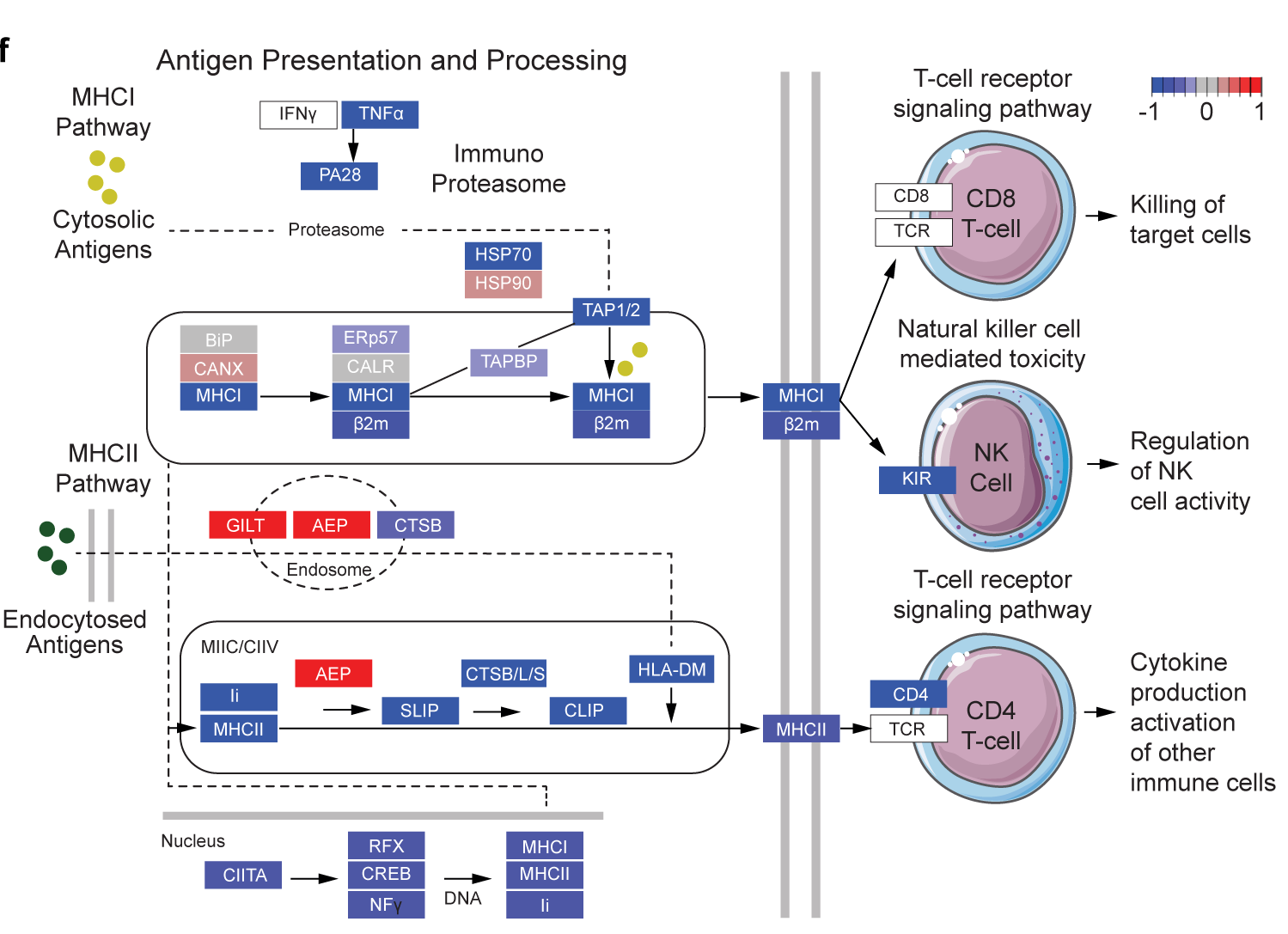
Image credit: Cancer Res (2026). https://doi.org/10.1158/0008-5472.CAN-25-1992


Reference
Adhikary U, Tesar B, Patel K, Schmidt MJ, Levy HR, Zacharakis E, Godes M, Gokhale PC, Hebert KM, Neuberg DS, Bird GH, Walensky LD. Cancer Susceptibility to Stapled Oncolytic Peptides is Dictated by Membrane Cholesterol and Inflammatory Signaling. Cancer Res. 2026 Mar 5. doi: 10.1158/0008-5472.CAN-25-1992.
Go to Cancer Research