 Medicine Innovates Medicine Innovates: Delivering innovations in medicine to the world for better health and prosperity

Significance
When caloric intake stays high for long enough, adipose tissue and liver begin to accumulate triglycerides at higher normal turnover, but the molecular controls that allow this to happen are not evenly distributed across regulatory layers. A fair amount of lipid handling seems to hinge on whether certain protein modifications can be written and erased as metabolic conditions shift. Acetylation and deacetylation fit neatly into this picture, given their tight dependence on acetyl-CoA. Nitric oxide–linked modifications appear everywhere, affect enzymes and the cytoskeleton alike, yet they still sit awkwardly in most metabolic models. De novo lipogenesis channels excess carbon into fatty acids through a small set of enzymes that have to operate within narrow bounds and push hard toward synthesis and oxidation suffers; pull back too far and storage collapses. In adipocytes, this balance determines whether cells enlarge and retain triglycerides. In hepatocytes, it influences steatosis and downstream stress responses. Transcription factors such as PPARγ, SREBP1, and CEBP family members organize the expression of the relevant enzymes, but their activity is not autonomous. It depends on what the cell can physically and chemically accommodate. Changes in actin organization, contractile tone, or even protein solubility can tip lipogenic programs toward continuation or failure and this kind of coupling makes simple regulatory diagrams feel incomplete. S-nitrosylation offers a way to think about this coupling. The modification is reversible and capable of altering both catalytic activity and cytoskeletal behavior. Its persistence seems to depend less on how much nitric oxide is produced than on how efficiently it is removed, which puts denitrosylases in a position to control signal duration. Enzymes in the SCoR family carry out this removal using coenzyme A, but their biological role has resisted a single explanation. Studies in yeast, zebrafish, and mammals have identified very different targets. It is still unclear whether these enzymes enforce a common metabolic logic or simply respond to local context. Obesity and metabolic dysfunction–associated steatotic liver disease highlight the limits of models that focus on intake and expenditure while paying less attention to intracellular erasure mechanisms. Human genetic links between regulatory enzymes and body mass suggest that these layers may bias lipid fate well before disease becomes obvious. What remains missing is a clear mechanistic bridge connecting denitrosylation, transcriptional control, and tissue-specific lipid flux.
A recent research paper published in Cell Signaling and conducted by Dr. Nicholas Venetos, Dr. Colin Stomberski, Dr. Hua-Lin Zhou, Zhaoxia Qian, Dr. Precious McLaughlin, Puneet Bansal, John Feczko, Ilya Bederman, Dr. Hoa Nguyen, Dr. Alfred Hausladen, Joseph Schindler, Zachary Grimmett, Henri Brunengraber, Dr. Richard Premont, and led by Professor Jonathan Stamler from the Case Western Reserve University, the authors developed a mechanistic framework linking SCoR2-dependent denitrosylation to lipid synthesis control in adipocytes and hepatocytes. They identified Myh9 as a cytoskeletal target that limits adipogenic transcription when S-nitrosylated and ACLY and FASN as hepatic enzyme targets with reduced activity under the same modification. The work distinguishes tissue-specific substrates under a shared chemical control process.
The research team examined human genetic data and identified a promoter variant associated with increased body mass that elevated transcriptional activity of the denitrosylase SCoR2. The investigators correlated SCoR2 abundance with adipocyte size in human tissue and with weight gain in mice, establishing a link between enzyme level and lipid storage capacity. To test necessity, the authors challenged SCoR2-deficient mice with obesogenic diets and observed resistance to weight gain without changes in food intake or absorption, directing attention away from behavior and toward intracellular synthesis. The researchers assessed adipose tissue directly and found reduced fat pad mass and smaller adipocytes across diets, prompting a focused analysis of lipid synthesis. Measurements of lipolysis failed to differ between genotypes, narrowing the explanation to synthetic pathways. Using primary cells and 3T3-L1 models, the study demonstrated impaired adipocyte differentiation and reduced neutral lipid accumulation when SCoR2 activity was absent, accompanied by blunted induction of CEBPβ and later suppression of PPARγ and CEBPα.
The authors interrogated transcriptional control more deeply and observed defective processing of SREBP1 without changes in its precursor abundance or transcript level. This separation between synthesis and activation suggested interference at a structural checkpoint. Proteomic screening identified the actomyosin regulator Myh9 as a prominent SCoR2-associated protein, and the researchers showed increased S-nitrosylation of Myh9 when SCoR2 was removed. Functional assays revealed enhanced actin polymerization and contractile assembly under these conditions, linking chemical modification to mechanical constraint. To establish causality, the investigators mutated specific cysteine residues on Myh9 and demonstrated resistance to nitric oxide–induced assembly when S-nitrosylation sites were removed. Reconstitution experiments restored transcription factor accumulation, tying cytoskeletal rigidity to transcriptional suppression. Pharmacological inhibition of nonmuscle myosin partially rescued lipid accumulation, though not completely, reflecting a trade-off between structural release and longer-term transcriptional commitment. The study extended these analyses to liver, where the researchers observed protection from steatosis in SCoR2-deficient animals. Unlike adipose tissue, hepatocytes did not rely on Myh9 modification. Instead, the authors identified direct S-nitrosylation of ACLY and FASN, confirmed reduced enzymatic activity, and measured diminished fatty acid synthesis. Stable isotope tracing and oxidation assays showed increased fatty acid oxidation, indicating a coordinated shift away from synthesis when denitrosylation was impaired. Liver-specific knockdown experiments demonstrated autonomy of the hepatic effect without altering adiposity, reinforcing tissue-dependent targeting. Throughout, the investigators acknowledged that incomplete cell-type–specific deletion limits resolution of cross-organ coupling, leaving some causal ordering implicit.
To summarize, the new work of Professor Jonathan Stamler and colleagues (known for discovery of S-nitrosylation ) assigns a unifying metabolic role to a denitrosylase previously associated with disparate targets. By linking S-nitrosylation turnover to both transcriptional permissiveness and enzymatic throughput, the findings connect chemical reversibility to physical and metabolic constraints inside lipid-handling cells. The distinction between adipocyte and hepatocyte targets clarifies how a single enzyme can bias storage in one tissue and oxidation in another without invoking separate regulatory logics. The identification of actomyosin rigidity as a gate on adipogenic transcription reframes cytoskeletal dynamics as an active participant in energy storage decisions. Structural flexibility emerges as a prerequisite for sustained lipogenesis, while enforced assembly restricts transcription factor maturation. In hepatocytes, direct modification of synthetic enzymes bypasses transcriptional control entirely, revealing parallel control paths that converge on lipid flux. Human genetic and tissue correlations ground these mechanisms in disease relevance, though the implications remain bounded by context. Interfering with denitrosylation alters lipid handling under dietary stress, yet different pathological settings may engage compensatory nitrosative or oxidative pressures. The tissue specificity observed here cautions against assuming uniform outcomes from systemic modulation. We believe the therapeutic strategies targeting lipid synthesis may benefit from considering eraser enzymes alongside writers. Modulating denitrosylation could redirect carbon flow without forcing global transcriptional shutdown, provided tissue balance is preserved. Whether such modulation remains beneficial across disease states, or requires coordinated targeting of multiple organs, remains an open constraint.
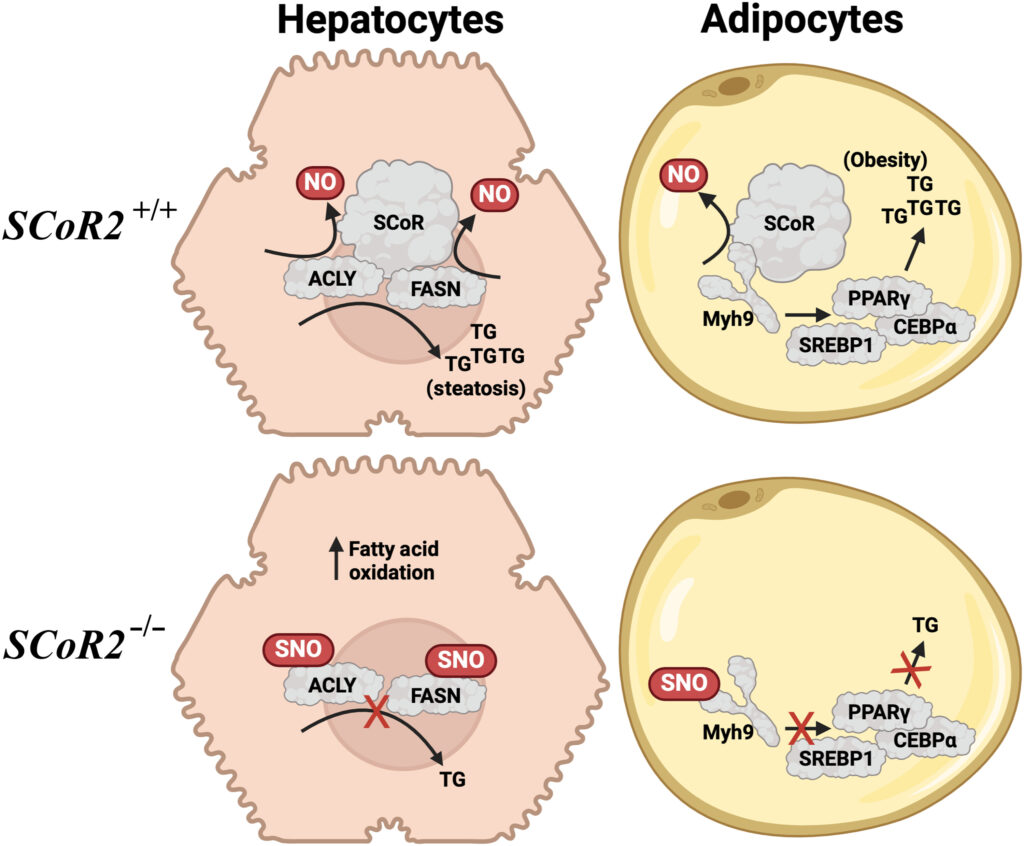
Figure legend: The protein denitrosylase SCoR2 regulates lipogenesis and fat storage

Reference
Venetos NM, Stomberski CT, Zhou HL, Qian Z, McLaughlin PJ, Bansal PK, Feczko J, Bederman I, Nguyen H, Hausladen A, Schindler JC, Grimmett ZW, Brunengraber H, Premont RT, Stamler JS. The protein denitrosylase SCoR2 regulates lipogenesis and fat storage. Sci Signal. 2025 Dec 23;18(918):eadv0660. doi: 10.1126/scisignal.adv0660.