 Medicine Innovates Medicine Innovates: Delivering innovations in medicine to the world for better health and prosperity

Significance
Fibroblast growth factors connect molecular signaling to processes such as cell growth, proliferation, tissue repair, and developmental regulation. Among them, fibroblast growth factor 2 (FGF2) is valuable for biomedical and applied research, but its β-barrel structure, built from β-pleated sheets and connecting loops, makes it a difficult recombinant target. In heterologous hosts, stable accumulation, proper folding, and efficient recovery of FGF2 cannot be assumed simply because the gene is transcribed and translated. The production challenge is also due to the limitations of current expression systems. Natural isolation from mammalian cells yields only limited quantities and raises biological and ethical concerns. On the other hand, bacterial and yeast platforms can produce recombinant proteins, but they depend on organic nutrient inputs, fermentation infrastructure, and culture conditions that may increase contamination risk. In contrast, photosynthetic organisms can provide an attractive alternative because they can grow without externally supplied organic carbon, however, plants and eukaryotic algae introduce other complications such as slow growth, more demanding transformation procedures, low expression, and degradation of non-native proteins by intracellular proteolytic systems. Synechocystis sp. PCC 6803 provides a different biological setting for this problem. As a unicellular cyanobacterium, it combines photosynthetic growth with stable genetic transformation, which makes it useful for synthetic biology approaches that seek to couple recombinant production with native cellular machinery. A central feature of Synechocystis is the phycobilisome light-harvesting apparatus, in which the highly expressed phycocyanin β-subunit CpcB forms part of a native photosynthetic structure required for efficient light capture and growth.
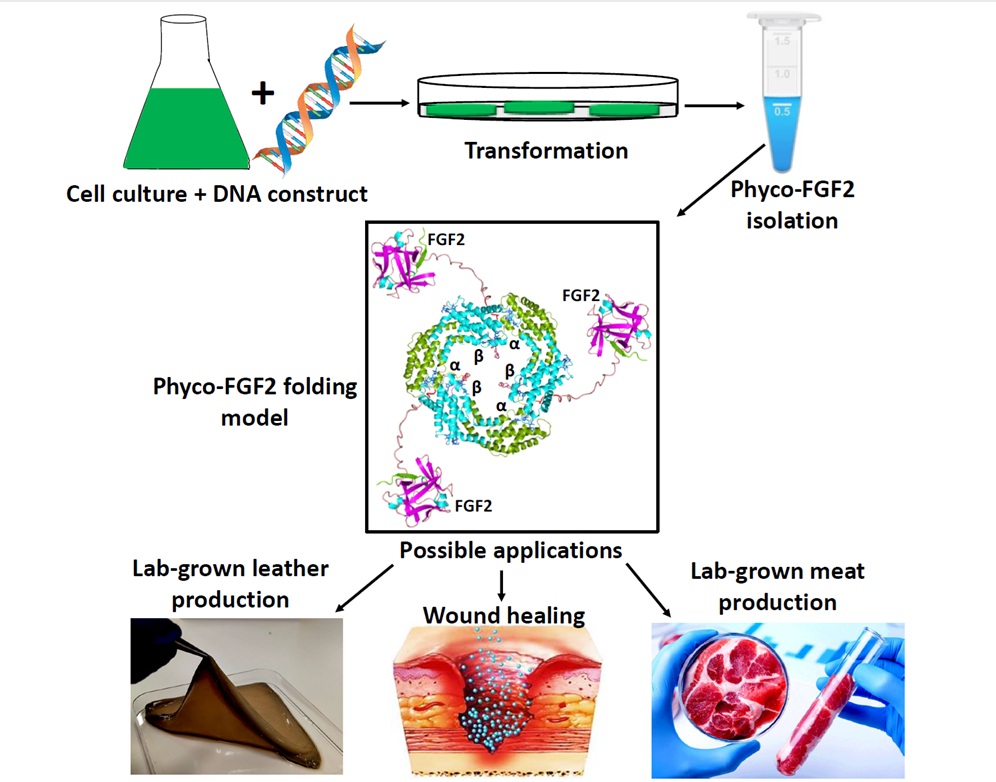
In a recent research paper published in ACS Synthetic Biology, postdoctoral fellow Dr. Bharat Kumar Majhi and Professor Anastasios Melis from the University of California Berkeley addressed this problem by asking whether FGF2 could be stabilized in Synechocystis through fusion to the phycocyanin β-subunit. They tested whether the abundance of a native photosynthetic protein could be used to support the accumulation, recovery, and functional retention of a structurally demanding growth factor. Briefly, Majhi and Melis designed two fusion constructs in which a codon-optimized bovine FGF2 sequence was placed in frame with cpcB within the native phycocyanin operon. One construct contained FGF2 without the eight-amino-acid N-terminal signaling segment, whereas the other retained this segment. In both designs, the modified CpcB protein carried a 6xHis tag, a short spacer, and a TEV protease recognition sequence before the FGF2 portion. By inserting FGF2 at the carboxyl-terminal side of CpcB while preserving a cleavable junction, the design tied FGF2 accumulation to a highly expressed photosynthetic protein and, at the same time, left open a route for later release of the growth factor from the fusion.
The authors found the transformed Synechocystis strains reached genomic DNA homoplasmy, as judged by PCR products corresponding to the modified loci and absence of the wild-type cpc operon product. Homoplasmy was important because mixed wild-type and transgenic genome copies would complicate physiological and biochemical interpretation. Once the strains were established, they remained capable of photoautotrophic growth, although their doubling times were slower than wild type under the subsaturating irradiance used for cultivation. The Syn*FGF2 and Syn*N*FGF2 strains doubled in about 42 and 50 hours, respectively, compared with about 28 hours for wild type. Their greener appearance and spectral profiles reflected reduced phycocyanin content, calculated at about 18.2% of the wild-type level after correction with the phycocyanin-lacking reference strain. The interpretation offered in the paper is structurally precise: the transformants appear to assemble only the proximal phycocyanin disc containing the modified Phyco*FGF2 β-subunit, rather than the full complement of middle and peripheral phycocyanin discs.
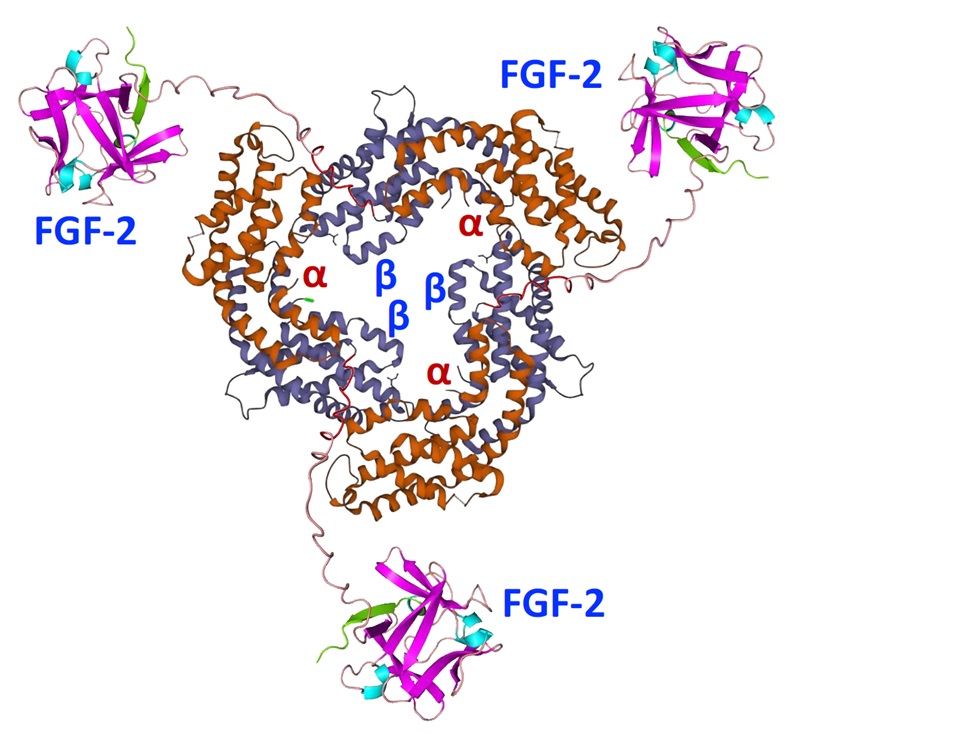
In wild-type cells, Majhi and Melis found the expected abundant phycocyanin CpcB band to be present at about 19 kDa while in the transformants, that band disappeared and was replaced by new bands at approximately 36 and 37 kDa, corresponding to Phyco*FGF2 and Phyco*N*FGF2. Zinc chromophore labeling confirmed that these bands retained the phycocyanobilin-associated character of phycocyanin, while Western blotting with FGF2 antibodies confirmed the presence of the FGF2 component. A secondary band near 30 kDa, also positive by zinc labeling and FGF2 immunoreactivity, was interpreted as an aberrantly migrating fraction of the fusion protein, consistent with the unusual behavior expected from an FGF2-containing construct. The critical comparison was with the nonfusion FGF2, expressed by itself under the cpc promoter: without fusion to CpcB, only trace FGF2 accumulated. Fusion to CpcB therefore changed the biological outcome from marginal detection to dominant accumulation. They isolated His-tagged fusion protein complexes from crude cyanobacterial lysates by cobalt affinity chromatography as modified heterohexameric phycocyanin disc complexes containing CpcA, the CpcG1 linker, and the CpcB-FGF2 fusion. Treatment with recombinant TEV protease progressively reduced the 36–37 kDa fusion band and produced the expected CpcB-derived cleavage fragment, with FGF2 migrating near the CpcA band and western blotting analysis showed that the 17 kDa FGF2 signal appeared only after TEV treatment. The authors’ fusion design therefore had a direct scientific consequence: it stabilized FGF2 during cyanobacterial expression as well as preserved the protease-accessible junction for recovery of the natural-size growth factor. They also tested biological activity using human embryonic kidney cells and found the isolated Phyco*FGF2 and Phyco*N*FGF2 complexes retained signaling activity relative to commercial natural FGF2 confirming that the cyanobacterial production strategy preserved its functional activity properties.
The two fusion versions behaved similarly in this assay, since the presence or absence of the eight-amino-acid N-terminal segment did not produce a discernible difference. Preliminary heat-treatment experiments also indicated retention of activity after 24 hours, suggesting that the phycocyanin disc environment may confer functional stability to the FGF2 moiety. A preliminary process analysis estimated Phyco*(N)*FGF2 at about 14% of biomass and cleaved isolated FGF2 at about 1.4% of biomass, with the authors treating these yield values cautiously because they were based on Coomassie staining.
A central innovation of the work of Professor Anastasios Melis and Dr. Bharat Kumar Majhi is the use of phycocyanin as a stabilizing carrier for FGF2 and such design is scientifically important because it links a structurally difficult growth factor to a native photosynthetic protein that the host cell naturally produces and incorporates into its light-harvesting machinery. In this way, the researchers used a native abundance pathway to support recombinant protein accumulation. The study therefore provides a useful synthetic-biology model for producing difficult growth factors in photosynthetic microbial hosts, with potential value for research systems that require accessible, functional, and recoverable biomedical proteins.


Reference
Majhi BK, Melis A. Engineering Fibroblast Growth Factor-2 (FGF2) Production in Cyanobacteria. ACS Synth Biol. 2025;14(10):3978-3989. doi: 10.1021/acssynbio.5c00388.
Go to ACS Synthetic Biology