 Medicine Innovates Medicine Innovates: Delivering innovations in medicine to the world for better health and prosperity

Significance
Precise genome editing is important tool molecular biology, biotechnology, and emerging therapeutic disciplines. However, despite the maturation of programmable nucleases such as CRISPR–Cas9, the reliable installation of defined DNA sequences into mammalian genomes remains constrained by fundamental limitations in donor template delivery and repair pathway choice. Homology-directed repair requires an exogenous DNA template to be present in the nucleus during a narrow temporal window following DNA cleavage, a requirement that has proven difficult to satisfy efficiently and reproducibly. Viral vectors can supply donor DNA but introduce concerns related to insertional mutagenesis, payload inflexibility, and regulatory complexity. Synthetic single-stranded oligodeoxynucleotides, while widely used, suffer from limited nuclear targeting, transient availability, and incompatibility with RNA-only delivery strategies. In response to these challenges, recent genome-editing approaches have sought to generate repair templates intracellularly, thereby localizing donor DNA production directly at the site of genome modification. Reverse-transcriptase-based systems exemplify this conceptual shift by coupling DNA synthesis to programmable nucleases. Among these, bacterial retrons represent a particularly intriguing yet underexplored class of molecular machines. Retrons naturally synthesize multicopy single-stranded DNA through a self-primed reverse transcription reaction, producing covalently linked RNA–DNA hybrids inside cells. This endogenous DNA production bypasses many of the logistical barriers associated with donor delivery and offers the possibility of sustained, localized template availability. Although retrons have been extensively studied in bacterial systems—primarily in the context of phage defense—their potential as genome-editing tools in eukaryotic cells has remained largely unrealized. Early demonstrations established proof-of-principle retron editing in mammalian cells, but efficiencies were modest and limited to a small number of retron reverse transcriptases. Moreover, the design space governing retron compatibility with mammalian repair pathways, nuclear trafficking, nuclease pairing, and delivery modality had not been systematically explored. As a result, retrons were viewed as conceptually promising but practically immature when compared to established donor-based editing strategies. To this end, new research paper published in Nature Biotechnology and conducted by Dr. Jesse Buffington, Dr. Hung-Che Kuo, Dr. Kuang Hu, Dr. You-Chiun Chang, Dr. Kamyab Javanmardi, Dr. Brittney Voigt, Dr. Yi-Ru Li, Dr. Mary Little, Dr. Sravan Devanathan, Dr. Blerta Xhemalçe, Dr. Ryan Gray, and led by Professor Ilya Finkelstein from the University of Texas at Austin, the researchers developed a retron-based genome-editing platform that synthesizes high-copy single-stranded DNA repair templates directly inside mammalian cells. By discovering and engineering highly active retron reverse transcriptases, they achieved precise DNA insertions with efficiencies comparable to synthetic donors, but from a genetically encoded cassette. The system functions with multiple CRISPR nucleases, supports double-strand-break-free editing, and is compatible with all-RNA delivery.
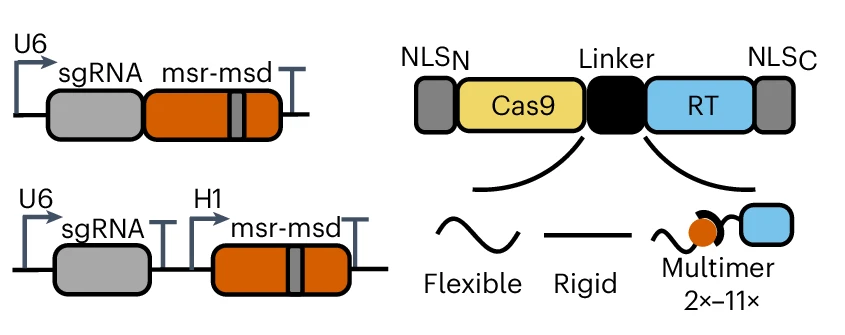
The research team conducted a large-scale bioinformatic survey of bacterial and archaeal genomes, identifying over five hundred high-confidence retron systems. From this set, ninety-eight retron reverse transcriptases were experimentally screened in mammalian cells using a fluorescence-based reporter that directly coupled homology-directed repair to restoration of protein function. This functional assay enabled direct comparison of retron activity under identical cellular conditions, revealing substantial performance heterogeneity across retron families. They found, a subset of retrons—predominantly derived from a specific phylogenetic clade—displayed editing efficiencies that exceeded those of the previously benchmarked Eco1 retron. Among these, one reverse transcriptase emerged as a consistent top performer across both transient and genomically integrated reporter systems. Deep sequencing confirmed that this retron supported highly accurate insertions, with error rates comparable to chemically synthesized single-stranded DNA donors, indicating that reverse transcription fidelity was not a limiting factor. Afterward, the authors undertook systematic molecular engineering of the retron editor architecture. Separating the retron RNA from the guide RNA unexpectedly improved editing efficiency, suggesting that RNA folding and steric constraints strongly influence retron performance. Optimization of nuclear localization signals and linker geometry between the nuclease and reverse transcriptase further refined activity, revealing that retron editors tolerate considerable architectural flexibility without loss of function. Notably, excessive multimerization of the reverse transcriptase proved detrimental, highlighting the importance of preserving native retron dynamics.
The engineered retron editors were then paired with multiple CRISPR nucleases. In addition to canonical Cas9, the system functioned robustly with Cas12a, substantially expanding the range of accessible genomic targets. Even more notably, retron editors retained activity when coupled to a Cas9 nickase, enabling templated insertions without introducing double-strand breaks. This observation suggested that retron-mediated editing can exploit alternative repair pathways beyond classical HDR. The team next modulated cellular DNA repair using both small-molecule inhibitors and nuclease–repair protein fusions. Inhibition of DNA-PK markedly enhanced templated insertion while simultaneously reducing error-prone end-joining signatures. These effects extended to larger DNA cargos, though insertion efficiency declined with increasing template length, consistent with reduced intracellular ssDNA abundance. Additionally, the retron platform was translated beyond plasmid delivery. By expressing all components as RNA, the authors achieved efficient DNA-free genome editing in mammalian cells. This RNA-only strategy was further validated in zebrafish embryos, where precise correction of a pathogenic mutation was achieved at measurable frequencies, confirming retron functionality in a vertebrate developmental context.
In conclusion, the work of Professor Ilya Finkelstein and colleagues established retron editors as a versatile and scalable alternative for precise genome modification. Indeed, the authors reposition donor synthesis as an intrinsic component of the editing machinery itself and by doing so, retron editors dissolve a long-standing bottleneck in precise genome modification: the need to synchronize nuclease activity with the fleeting presence of an exogenous repair template in the nucleus. The demonstration that retron-derived single-stranded DNA can support insertion efficiencies comparable to synthetic donors fundamentally alters how templated editing can be approached. Because the donor template is genetically encoded, retron editors decouple editing efficiency from transfection efficiency, DNA stability, and nuclear import. This distinction is particularly consequential for cell types and organisms where DNA delivery is inefficient or undesirable, including primary cells, embryos, and in vivo therapeutic contexts. We believe the system’s compatibility with multiple nucleases and repair modalities. The ability to operate with Cas12a broadens targetable genomic landscapes, while successful nickase-based editing suggests a pathway toward double-strand-break-free precision editing. This feature addresses a major safety concern associated with current genome-editing technologies, particularly in clinical applications where chromosomal rearrangements and off-target indels pose significant risks. Moreover, the study provides a rare example of rational pathway steering yielding predictable gains in editing outcome. By combining retron editors with selective inhibition of nonhomologous end joining, the authors demonstrate that cellular repair processes can be tuned to favor templated insertion without globally compromising genome integrity. This findingt reinforces the view that future genome-editing platforms will increasingly rely on integrated control of both molecular tools and endogenous repair biology.
Furthermore, retron editors open new possibilities for functional genomics. The ability to install defined sequence variants, epitope tags, or regulatory elements from a compact genetic cassette is ideally suited for high-throughput variant screening and multiplexed editing strategies. Because retrons naturally generate multiple copies of donor DNA, they are particularly well aligned with applications requiring uniform editing outcomes across cell populations. Finally, the successful demonstration of all-RNA retron delivery positions this technology at the intersection of genome editing and mRNA therapeutics. As RNA-based delivery platforms continue to mature, retron editors offer a uniquely compatible route to precise, programmable DNA modification without introducing foreign DNA. Collectively, this work establishes retrons not as incremental alternatives, but as a distinct and powerful paradigm for precision genome engineering.


Reference
Jesse Buffington, Hung-Che Kuo, Kuang Hu, You-Chiun Chang, Kamyab Javanmardi, Brittney Voigt, Yi-Ru Li, Mary Little, Sravan Devanathan, Blerta Xhemalçe, Ryan Gray, Ilya Finkelstein. Discovery and engineering of retrons for precise genome editing. Nature Biotechnology, 2025; DOI: 10.1038/s41587-025-02879-3
Go to Journal of Nature Biotechnology.