 Medicine Innovates Medicine Innovates: Delivering innovations in medicine to the world for better health and prosperity

Significance
Residual hepatocellular carcinoma cells that are left at a surgical margin can proliferate fast before a patient-specific vaccine is even ready, this is because the process of neoantigen identification, selection, and individualized manufacturing can consume much of the postoperative window. Neoantigen peptides can carry exquisite tumor specificity, but they often fail to generate enough immune pressure on their own to control residual disease. Adjuvants can push the system harder, though that route brings its own limitations in stability and immune toxicity. Preassembled delivery platforms have helped with speed, but they have not fully answered the immunogenicity problem. In a recent research paper published in ACS Nano, Dr. Shujun Zhou, Dr. Chufan Wang, Dr. Yuxiang Ning, Dr. Yunhao Wang, Dr. Fei Xin, Dr. Lei Ren, and Professor Yanfeng Wang from the Zhongnan Hospital of Wuhan University, developed an HBc virus-like particle nano-vaccine platform in which a catcher sequence engineered into the major immunodominant region covalently ligates tagged neoantigen peptides through split autocatalytic amide-bond chemistry. They used that platform to assemble HBc-MWK, a three-neoantigen hepatocellular carcinoma vaccine prepared within three days. The distinct feature is that the prebuilt immunogenic chassis and the patient-specific antigen step are separated, so personalization does not require rebuilding the carrier from the beginning.
Briefly, the authors used plug-and-display design based on split autocatalytic amide-bond chemistry derived from a fibronectin-binding protein domain. One segment, the catcher, was inserted into the major immunodominant region of the HBc particle; the complementary tag was appended to selected neoantigen peptides. The intellectual appeal of that choice is pretty direct: if the chassis can be prepared in advance and the patient-specific step collapses to rapid peptide ligation, then the time problem changes from full vaccine reconstruction to targeted assembly. At the same time, the HBc shell carries its own immunological logic, because ordered antigen display and intrinsic T-helper epitopes could compensate, at least in part, for the usual weakness of isolated neoantigen peptides. The research team selected three hepatocellular carcinoma neoantigen peptides from an earlier screening set of twenty candidates identified through sequencing, MHC-affinity analysis, and ELISPOT testing, then attached tag sequences to each peptide and linked them to a catcher-engineered HBc nanochassis. The investigators produced the chassis in E. coli, purified it, and allowed it to self-assemble into virus-like particles that retained the expected hollow spherical morphology and an average size of about 34 nm after antigen conjugation. The authors also examined pH stability and blood compatibility, and they found that the assembled vaccine remained reasonably stable across mildly acidic to weakly alkaline conditions and produced no meaningful hemolysis; they extended that safety profile with organ histology and blood biochemistry after repeated dosing in mice. For postoperative use, manufacturing speed, formulation stability, and tolerability need to remain aligned, because rapid assembly alone would not be enough if the vaccine proved difficult to handle or dose repeatedly.
Afterward, the researchers examined whether the assembled construct actually changed immune behavior at the cellular level and to do this, they tracked fluorescently labeled HBc-MWK in dendritic cells and observed uptake that peaked around 12 hours, which is consistent with rapid internalization and subsequent antigen processing. They also performed ELISPOT assays and found stronger reactivity for the three-antigen construct than for the single-antigen versions under matched antigen dosing, which argues that antigen combination did more than simply add mass to the particle. The study measured dendritic-cell maturation at 69% for HBc-MWK, a level that exceeded their earlier unconjugated neoantigen mixture even when that earlier approach included adjuvant support. The authors cocultured vaccine-treated dendritic cells with splenic T cells and recorded strong IFN-γ secretion together with higher IL-12p70, IL-27, TNF-α, and GM-CSF. They also observed the vaccine to increase T-cell proliferation and was associated with stronger functional activation, which indicate a robust cell-mediated immune response. The investigators also carried the analysis into lymph nodes and tumor models and observed early lymph-node accumulation after subcutaneous administration, increased maturation of antigen-presenting cells in draining nodes, and a higher proportion of CD8+IFN-γ+ T cells for the triple-antigen vaccine than for any single-antigen formulation. In the xenograft model, the authors recorded a tumor suppression rate of 97% for HBc-MWK and documented strong intratumoral infiltration by both CD4+ and CD8+ T cells. They also tested recurrence after resection in subcutaneous and orthotopic models, where the vaccine prevented recurrence in most animals and supported central memory T-cell formation.
To summarize, Professor Yanfeng Wang and colleagues, demonstrated the establishment of a new platform across dendritic-cell activation studies, xenograft therapy, and postoperative recurrence models, including an orthotopic setting. By preparing the HBc chassis in advance and reserving the patient-specific step for rapid peptide ligation, the team move personalization closer to a modular manufacturing model and this is important because postoperative recurrence is governed by time. Indeed, a vaccine that arrives after micrometastatic regrowth has already accelerated may be clinically late.
The work also pushes back against a quiet assumption in neoantigen vaccination: that specificity alone will carry the immune burden. Neoantigen peptides can be exquisitely selected and still behave weakly once delivered. The HBc particle changes that equation by imposing dense, repetitive presentation on the antigen set and by bringing its own T-helper context. In other words, the platform does not treat the carrier as inert packaging. It treats particle architecture as part of the immunological mechanism. That is a useful design principle, especially for cancers such as hepatocellular carcinoma, where residual disease after surgery may be heterogeneous, regionally immunosuppressive, and capable of slipping past single-target pressure.
There is another point here that deserves emphasis. The triple-neoantigen construct outperformed the single-antigen versions across immune readouts and recurrence models, which gives a practical answer to tumor heterogeneity. Multi-antigen display broadens immune recognition and may reduce the risk of escape across heterogeneous tumor cell populations. The memory data matter for the same reason. A postoperative vaccine is not only trying to shrink visible disease; it is trying to alter the terms of future tumor re-emergence. Clinical translation will depend on how efficiently antigen selection, patient-specific validation, and manufacturing can be integrated in practice. These questions will need to be addressed as the platform moves toward broader translational evaluation and a modular VLP chassis, covalent plug-and-display chemistry, and multi-neoantigen loading together define a route that could be useful when rapid turnaround and durable immune pressure matter at the same time. For postoperative hepatocellular carcinoma, this is precisely the setting in which such a technology could prove especially valuable.
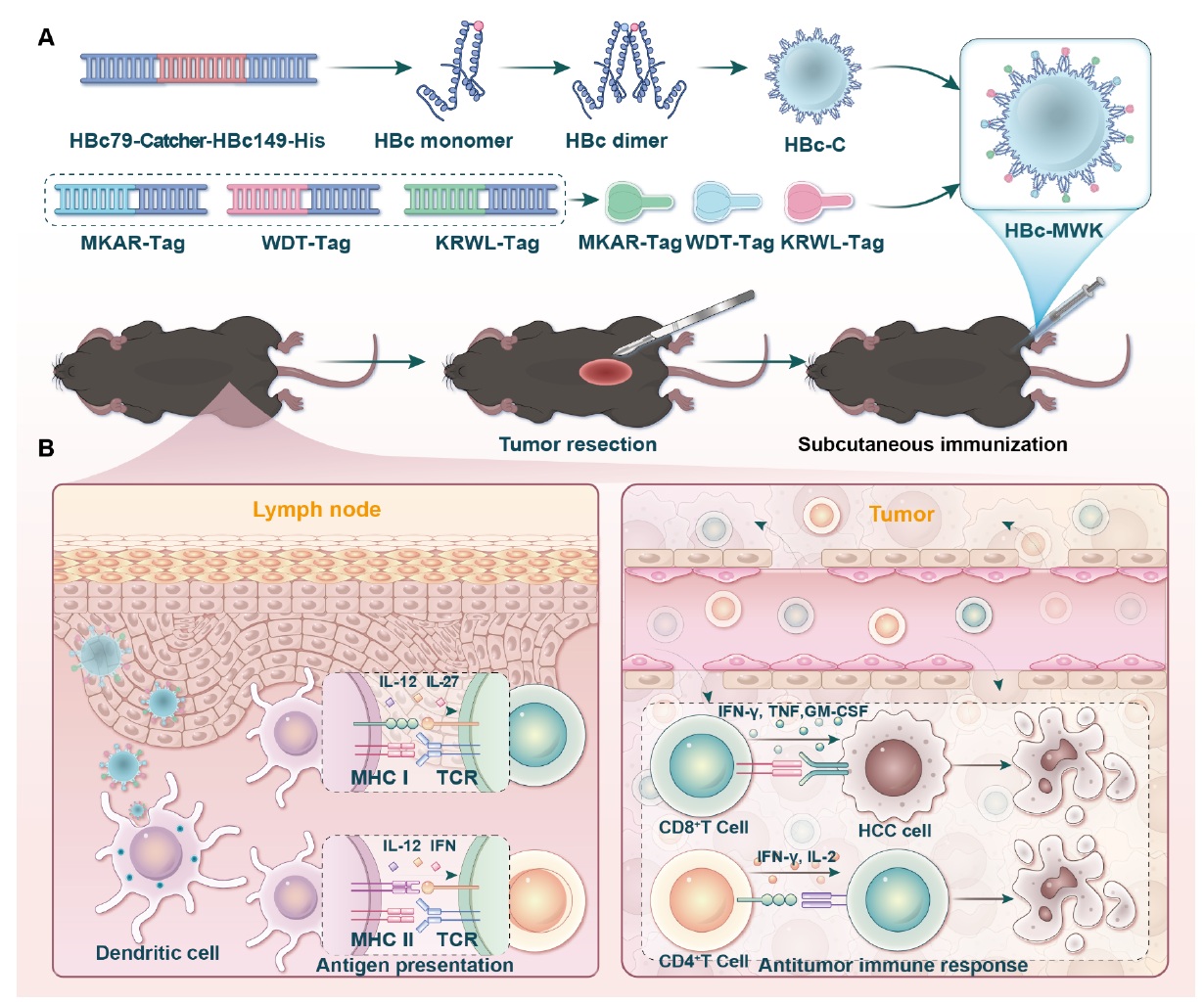
Schematic illustration of the construction of the HBc-MWK nanovaccine and its mechanistic prevention of tumor recurrence. (A) Construction of the HBc VLPs chassis and synthesis and conjugation of tagged antigens. (B) The immunotherapeutic process by which HBc-MWK inhibits HCC recurrence. ACS Nano. 2025;19(40):35385-35400. doi: 10.1021/acsnano.5c06278.
Reference
Zhou S, Wang C, Ning Y, Wang Y, Xin F, Ren L, Wang Y. Virus-Like Particle-Based Personalized Neoantigen Nano-Vaccine for Tumor Immunotherapy and Recurrence Prevention. ACS Nano. 2025;19(40):35385-35400. doi: 10.1021/acsnano.5c06278.
Go to Journal of ACS Nano