 Medicine Innovates Medicine Innovates: Delivering innovations in medicine to the world for better health and prosperity

Significance
Viral entry stalls whenever the envelope glycoprotein gp120 fails to engage the CD4 receptor with enough affinity to initiate the conformational cascade that ultimately drives membrane fusion. That interaction of gp120 with CD4 has been dissected repeatedly over the years, partly because it marks one of the earliest checkpoints in HIV infection where intervention is still possible. Much of the therapeutic antibody effort has therefore circled around this contact surface. The logic is fairly straightforward: if something can occupy or distort the gp120 regions responsible for CD4 recognition, the virus loses its foothold on the host cell. Broadly neutralizing antibodies have shown that this strategy can work, at least under certain conditions, since they recognize conserved regions of the envelope glycoprotein and reduce viral replication. However, HIV mutates relentlessly and even minor sequence shifts along exposed segments of gp120 can reshape the antigenic surface just enough for viral variants to slip past antibodies that once worked quite well.
Because of that mutational flexibility, combinations of antibodies have gradually become a common solution due to that different antibodies target different epitopes, so escape from one does not necessarily guarantee escape from the others. Several studies have supported this approach, both experimentally and clinically. The drawback, though, emerges once more than a few antibodies enter the mixture and manufacturing becomes complicated and regulatory evaluation also becomes less straightforward. Multispecific antibodies emerged from attempts to compress the same idea into a single molecular entity. In principle, one engineered antibody could bind multiple epitopes at once. Various formats have already been developed, including bi- and trispecific constructs. Even four binding arms might be incorporated within a conventional immunoglobulin scaffold. The difficulty, however, lies in the assembly. Multiple variable domains must fold and pair correctly, and that process does not always proceed cleanly. Mispairing, partial unfolding, or aggregation often creep into the picture. Another direction, somewhat unconventional at first glance, considers whether antigen-binding fragments might function outside a conventional antibody scaffold. Gold nanoparticle surfaces provide an unusual testing ground for that idea. Peptides attach readily through thiol groups and spread across the metallic interface. Earlier work introduced what are now called “goldbodies,” artificial antibody-like constructs generated by grafting complementarity-determining regions onto gold nanoparticles.
The difficult part, comes back to folding because antibody loops typically depend on the surrounding immunoglobulin framework to stabilize their shape. Remove that framework and the loops usually collapse into flexible, nonfunctional conformations. The goldization strategy proposes something slightly different. Multiple Au–S bonds restrict peptide motion across the nanoparticle surface, and those constraints appear to allow the binding loops to regain a configuration resembling their native state. The confined lowest energy fragment hypothesis attempts to rationalize this effect and antigen-binding fragments might not require a full antibody scaffold after all. One begins to imagine artificial antibody assemblies assembled directly on nanoparticles, with valence and composition extending well beyond what conventional immunoglobulins can realistically support. A recent research paper published in ChemMedChem and conducted by Mr. Yiwei Sun, Ms. Rui Ni, Dr. Yuan-Yuan Liu, Dr. Haifang Wang, and led by Professor Aoneng Cao from the Institute of Nanochemistry and Nanobiology at Shanghai University, the researchers engineered artificial antibodies termed goldbodies by attaching antigen-binding peptide fragments from anti-gp120 nanobodies as well as the gp120-binding fragment of CD4 onto 3.6 nm gold nanoparticles. Each nanoparticle displayed multiple peptide loops capable of regaining functional conformation after Au–S conjugation. The researchers also constructed a mixed particle carrying four different binding fragments simultaneously, forming a candidate tetraspecific gp120-binding system. Binding assays confirmed strong and selective recognition of gp120 by these nanoparticle-based antibody mimics.
Briefly, the Shanghai University investigators designed four peptide fragments capable of recognizing HIV gp120 by extracting binding motifs from known protein–gp120 complexes. One peptide derived from a CD4 fragment that participates directly in gp120 recognition, while three additional peptides reproduced CDR3 loops from nanobodies A12, J3, and D7 that engage different epitopes on the viral envelope glycoprotein. Each fragment received sequence adjustments that allowed attachment to gold nanoparticles through terminal cysteine residues while maintaining structural flexibility required for refolding. Each peptide exhibited a distinct density range in which binding responses to gp120 reached a maximum, roughly twenty peptides per particle for the CD4-derived fragment and lower densities for the nanobody loops. The authors used circular dichroism spectroscopy to examine structural changes induced by nanoparticle attachment and found free peptide corresponding to the CD4 fragment adopted a disordered conformation in solution, but the conjugated form displayed spectral characteristics consistent with β-hairpin structure. This observation supports the notion that the gold surface constrains the peptide in a geometry resembling its original state within CD4. Loop-derived nanobody fragments lacked diagnostic spectral signatures distinguishing folded and disordered forms, so the investigators relied on binding assays as indirect evidence of functional refolding. They found all four goldbodies produced strong responses toward gp120 yet minimal interaction with the control proteins (bovine serum albumin and immunoglobulin G), while free peptides displayed no measurable binding. Interestingly, the authors prepared a mixed conjugate containing four peptide types in equal proportions, yielding a construct termed GbMix. Kinetic analysis using surface plasmon resonance revealed nanomolar to subnanomolar dissociation constants for the individual goldbodies and for the mixed particle. The GbMix construct displayed particularly strong affinity for gp120, a result that raises the possibility of cooperative binding interactions among fragments targeting distinct epitopes. The investigators acknowledged that such cooperation remains uncertain, since multivalent nanoparticle systems complicate quantitative affinity interpretation.
Antibody fragments normally rely on a large protein architecture to stabilize binding loops, on the other hand goldization replaces that framework with a nanoscale inorganic platform that imposes spatial restriction through surface bonding. This change in scaffold architecture produces several practical consequences. Conventional multispecific antibodies require careful pairing of heavy and light chains from different parental antibodies. Structural incompatibility often introduces misfolding or aggregation, especially as additional specificities enter the design. Gold nanoparticle scaffolds bypass these assembly problems because each peptide attaches independently. Antigen-binding fragments do not require cooperative folding with neighboring fragments to retain activity. Another implication involves valence. A conventional immunoglobulin contains four binding arms at most, while nanoparticle surfaces offer many potential attachment sites. Even a small particle near the size of a nanobody can accommodate multiple peptides, and larger particles could support dozens of binding fragments. Viral mutation would then require simultaneous alterations across multiple antigenic regions to escape recognition.
The work of Professor Aoneng Cao and colleagues on artificial antibody systems based on nanoparticle scaffolds introduces a unique hybrid between nanotechnology and immunochemistry and instead of re-engineering entire antibody frameworks which is labor intensive process, researchers can explore combinations of short antigen-binding motifs assembled directly on nanoscale materials. If future work confirms multispecific viral neutralization, the new design principle could influence strategies for treating rapidly mutating pathogens as well as cancer antigens that exhibit heterogeneous surface expression.
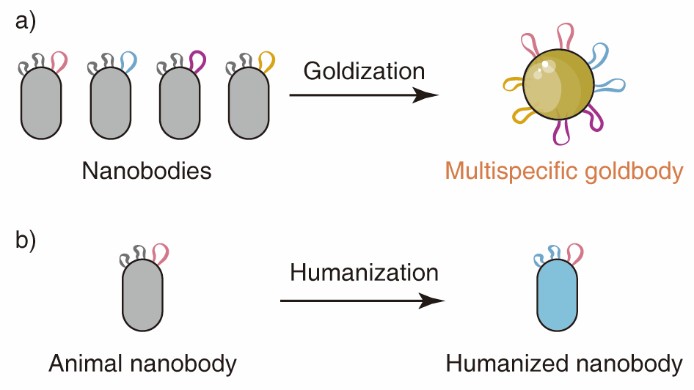
Figure legend: Multispecific artificial antibody created by grafting the CDRs of different antibodies onto the same gold nanoparticle via a unique goldization technology (a), which resembles the humanization technology (b).

Reference
Sun Y, Ni R, Liu YY, Wang H, Cao A. Towards Multispecific Anti-Gp120 Artificial Antibody. ChemMedChem. 2025;20(15):e202500287. doi: 10.1002/cmdc.202500287.
Go to ChemMedChem.