 Medicine Innovates Medicine Innovates: Delivering innovations in medicine to the world for better health and prosperity

Significance
Sustained immune pressure in the colon often fails to suppress epithelial tumor growth even when cytotoxic lymphocytes are present at high density. In colorectal cancer, immune infiltration does not map cleanly onto the expectations formed from other solid tumors, and regulatory T cells provide one of the clearest examples of this mismatch. In many cancers, accumulation of Foxp3-expressing T cells coincides with immune suppression and disease progression. Colorectal tumors depart from this pattern. Clinical datasets repeatedly report neutral or even favorable associations between regulatory T cell abundance and patient outcome, a finding that has resisted simple explanation. Several lines of reasoning have attempted to reconcile this inconsistency. One proposal assigns the anomaly to technical confounds, such as difficulty separating bona fide regulatory cells from activated effector populations that transiently express Foxp3. Another explanation emphasizes the distinct microbial and metabolic pressures of the intestinal environment, which shape immune differentiation in ways that differ from sterile tissues. Neither account fully resolves why removing regulatory T cells in experimental colorectal tumors often produces little change in growth, despite their clear suppressive roles elsewhere. A deeper challenge lies in the assumption that regulatory T cells operate as a single functional class. Colonic immune compartments support multiple regulatory lineages that differ in origin, transcriptional wiring, and cytokine output. Some subsets arise through peripheral conversion under microbial stimulation, while others derive from thymic selection and adapt locally. These distinctions matter because regulatory cells do not only restrain effector lymphocytes; they also shape myeloid recruitment, epithelial repair, and cytokine balance. Collapsing these activities into a single average effect obscures opposing contributions that may cancel at the tissue level. Colorectal cancer brings this problem into sharper focus. The tumor microenvironment shares features with inflamed mucosa, including exposure to microbial products and type 3 cytokines, yet introduces additional constraints through oncogenic signaling and stromal remodeling. Understanding how regulatory T cells behave under these conditions requires resolution beyond bulk counts or pan-depletion strategies. The intellectual motivation behind the present work emerges from this gap: if regulatory T cells in colorectal tumors are heterogeneous, then some subsets may actively restrain tumor growth while others support it. Distinguishing these functions demands approaches that integrate transcriptional identity, spatial context, and direct perturbation within a disease-relevant setting.
A recent research paper published in Journal of Immunity and conducted by Xiao Huang, Dan Feng, Sneha Mitra, Emma Andretta, Nima Hooshdaran, Aazam Ghelani, Eric Wang, Joe Frost, Victoria Lawless, Aparna Vancheswaran, Qingwen Jiang, Cheryl Mai, Karuna Ganesh, Christina Leslie, and led by Professor Alexander Rudensky from the Memorial Sloan Kettering Cancer Center in New York, the authors developed an integrated genetic and single-cell framework to separate regulatory T cell subsets in colorectal cancer by cytokine function. They combined selective in vivo ablation with transcriptional and chromatin profiling to assign opposing tumor roles to Il10-positive and Il10-negative populations. The research team addressed regulatory T cell heterogeneity using an orthotopic mouse model that reproduces key genetic and immunological features of microsatellite-stable colorectal cancer. The investigators implanted organoids carrying Apc, Trp53, and Kras mutations into the cecal wall, generating tumors that resisted PD-1 blockade and accumulated regulatory T cells, mirroring human disease. Using single-cell RNA and chromatin accessibility profiling, the authors examined T cells isolated from tumors and adjacent colon, resolving regulatory populations based on interleukin-10 expression.
The analysis separated Foxp3-positive cells into two dominant subsets. One population expressed Il10 alongside transcriptional programs associated with RORγt, while the other lacked Il10 and showed enrichment for Helios-linked circuitry. The study tracked these subsets over tumor progression and observed a shift in relative abundance: Il10-negative regulatory cells accumulated within tumors, whereas Il10-positive cells remained prevalent in non-tumor colon. Fate-mapping experiments demonstrated limited interconversion, indicating that the divergence reflected stable differentiation rather than transient activation states.
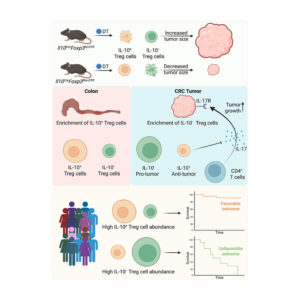
To test functional consequences, the researchers performed selective genetic ablation of each subset. Removal of Il10-negative regulatory cells reduced tumor burden and increased cytotoxic and type 2 immune features. In contrast, depletion of Il10-positive regulatory cells enlarged tumors without reducing total T cell infiltration. The authors traced this effect to changes in cytokine balance rather than global immune suppression. Il10-positive regulatory cells constrained interleukin-17 production by CD4 T cells, and their absence released a type 3 inflammatory program that favored tumor growth. The investigators directly examined this pathway by manipulating cytokine signaling. They showed that interleukin-17 enhanced growth of colorectal tumor organoids and that tumors lacking the IL-17 receptor failed to respond to regulatory T cell perturbation. Blocking IL-10 signaling reproduced the effects of Il10-positive regulatory cell depletion, reinforcing the link between regulatory-derived IL-10, control of IL-17, and epithelial proliferation. These experiments also exposed a trade-off: regulatory cells that dampen inflammation in normal mucosa can either protect or promote tumor growth depending on which cytokine circuits they restrain. Parallel analyses in human colorectal tumors confirmed the presence of transcriptionally similar regulatory subsets. The authors correlated subset abundance with patient survival and extended the comparison to other barrier-associated cancers, where analogous populations appeared with tissue-specific prevalence.
To summarize, the new work of Professor Alexander Rudensky and colleagues establishes IL-10–mediated control of IL-17 as a key axis linking regulatory T cells to epithelial tumor proliferation. It alters how regulatory T cells we interpret in colorectal cancer and instead of treating these cells as uniformly suppressive, we can think of them as internally divided, with opposing effects that depend on cytokine control rather than simple effector inhibition. The findings clarify why broad regulatory T cell depletion produces inconsistent outcomes in colorectal tumors and why immunotherapies extrapolated from other cancers underperform in this setting. The implications extend beyond colorectal cancer. Barrier tissues encounter microbial signals that favor type 3 immunity, and regulatory mechanisms that restrain these responses may indirectly limit tumor-promoting inflammation. In such contexts, eliminating regulatory cells wholesale risks amplifying cytokine programs that accelerate epithelial growth. The work encourages a more selective view of immune modulation, one that distinguishes regulatory subsets by function instead of lineage markers alone. From a therapeutic perspective, the paper indicated conditional strategies and targeting regulatory populations that suppress cytotoxic or type 2 responses may benefit tumors dominated by those pathways, while preserving regulatory control of IL-17 may be advantageous in epithelial cancers sensitive to type 3 cytokines. These considerations place boundaries on immunotherapeutic design rather than offering a single prescription. They also highlight the need for biomarkers that resolve regulatory heterogeneity in patient samples, since aggregate Foxp3 measurements lack predictive value.

Reference
Huang X, Feng D, Mitra S, Andretta ES, Hooshdaran NB, Ghelani AP, Wang EY, Frost JN, Lawless VR, Vancheswaran A, Jiang Q, Mai C, Ganesh K, Leslie CS, Rudensky AY. Opposing functions of distinct regulatory T cell subsets in colorectal cancer. Immunity. 2026 Jan 13;59(1):145-160.e9. doi: 10.1016/j.immuni.2025.11.014.